Insights
A Year of Workplace Conversations
See what New Zealand employees think about workplace culture, career progression, flexible work, leadership effectiveness and AI adoption.


Insights
See what New Zealand employees think about workplace culture, career progression, flexible work, leadership effectiveness and AI adoption.
Over the past year, employees across Aotearoa shared honest perspectives on workplace culture through our anonymous survey.
They represented different industries, professions, career stages and organisational environments. Some were thriving. Others were frustrated. Most sat somewhere in between.
What emerged was not a picture of a workforce in crisis. In many respects, people spoke positively about their work. They valued supportive colleagues, flexibility, autonomy and meaningful responsibilities. Yet running beneath the responses was a quieter theme: a growing sensitivity to the gap between what organisations say they value and what employees experience in practice.
The survey findings suggest employees are not looking for radically different workplaces. If anything, expectations are becoming more refined. People are paying closer attention to whether organisational values show up consistently in everyday experiences.
As we reviewed the responses, a clear pattern emerged. The strongest signals in the data were often found in the gaps: between satisfaction and feeling valued, between flexibility as a policy and flexibility in practice, and between recognising the importance of career growth and actively supporting it.
These may appear to be separate issues, but they are closely connected. Together, they paint a picture of a workforce that remains engaged and optimistic, while becoming increasingly thoughtful about what makes an organisation worth committing to.
Many respondents spoke positively about aspects of their workplace. Overall employer satisfaction remained relatively positive across the data. However, when employees were asked whether they felt valued by their employer, scores were consistently lower.
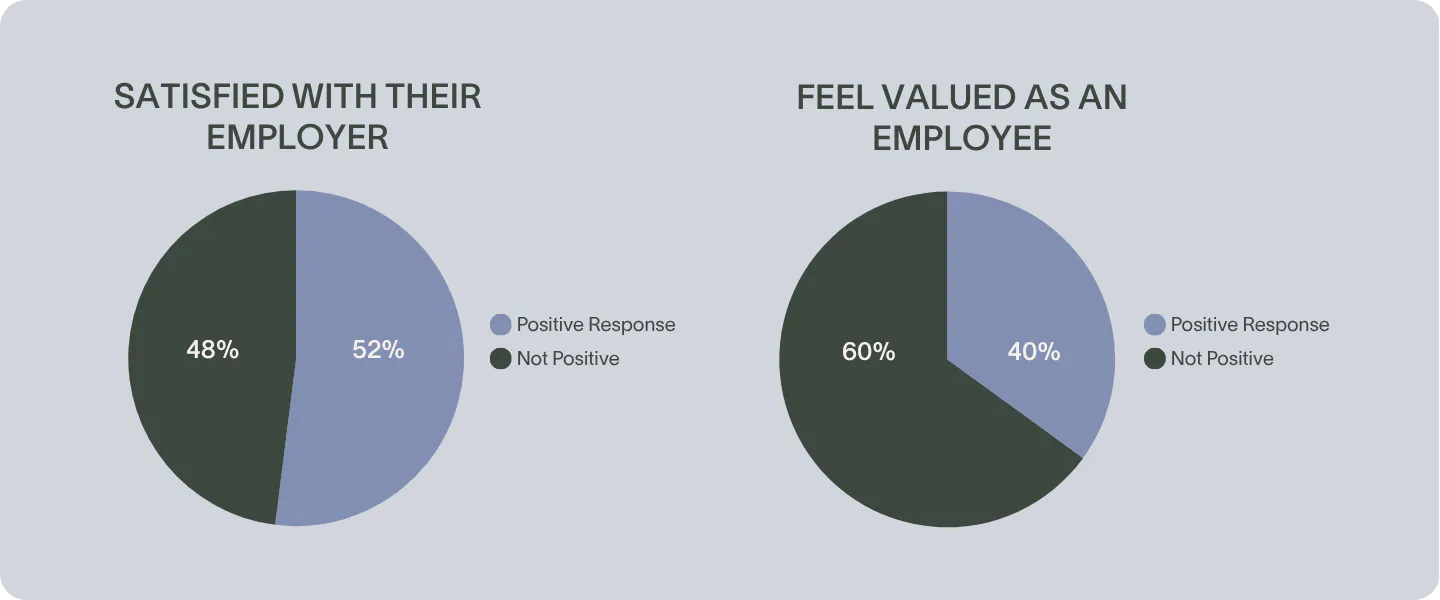
At first glance, that may seem like a subtle distinction. In practice, it reveals an important disconnect.
Satisfaction reflects how people feel about their day-to-day experience at work. Employees may enjoy their role, appreciate their colleagues, value flexibility, or feel they have opportunities to develop. These factors can contribute to a positive employment experience and help explain why satisfaction levels remain reasonably strong.
Feeling valued is different. It reflects whether employees believe their contribution genuinely matters to the organisation. While people may be satisfied with their role, colleagues, or working conditions, that does not necessarily mean they feel recognised or important to the wider organisation.
The survey responses reinforce this distinction. This suggests that a positive work environment does not automatically create a strong sense of recognition or belonging. Employees can have rewarding day-to-day experiences while still feeling uncertain about how much their contribution matters to the organisation as a whole.
This gap matters because satisfaction alone is not necessarily a measure of attachment. People who are satisfied may stay, perform well, and speak positively about aspects of their workplace. But when employees do not feel valued, the relationship can become more transactional over time.
The findings suggest that organisations should not assume satisfaction and feeling valued move in tandem.
A useful test is to ask employees not whether they enjoy their job, but whether they can point to a recent moment when the organisation demonstrated that their contribution mattered. If people struggle to recall a specific example, it may indicate that positive working conditions are being experienced without a corresponding sense of recognition or value.
When asked how well their employer supports remote work and flexible scheduling, on a scale of 1 (poor) to 5 (excellent), respondents gave an average score of 3.41. That's a majority-positive result: 56% rated it a 4 or 5. Yet a sizeable minority disagreed. Respondents’ satisfaction with their ability to maintain a healthy balance between work and life outside work tracked closely alongside this measure, averaging 3.46 out of 5.
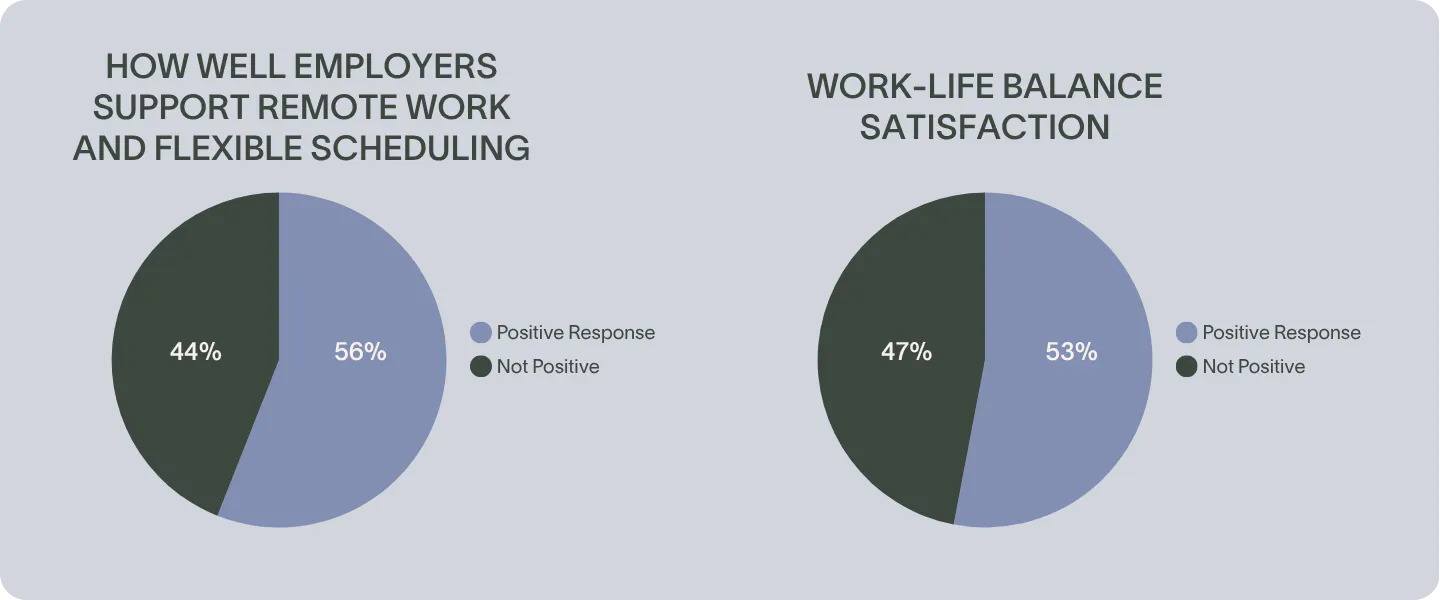
A score like that can look deceptively reassuring, but averages can conceal important differences in employee experience. While most respondents viewed flexibility positively, more than one in four did not. The challenge is therefore less about whether flexible work policies exist and more about whether they are being experienced consistently across the workforce.
What emerged from the open-ended responses was not a blanket demand for permanent remote work, but a desire for flexibility that accommodates real-life responsibilities, reflects trust in employees' judgement, and is consistently experienced rather than simply documented in the employee handbook. Several respondents described a growing disconnect between formal policy and day-to-day reality, with expectations around office attendance becoming increasingly implicit or workplaces lacking sufficient capacity for the employees being encouraged back on site.
Trust sits at the heart of the flexibility conversation. For many employees, flexibility represents far more than a choice about location or hours. When flexibility is formally offered but informally discouraged, or gradually narrowed through practice rather than policy, employees often interpret that inconsistency as an indicator about how much faith the organisation places in them.
The responses suggest that debates about flexibility are often less about the arrangement itself than what it communicates. Employees expect a degree of autonomy and trust in how they manage their work. When organisations respond with excessive oversight, surveillance-style management, or unspoken pressure to return to the office, the message received can be very different from the one intended. The issue is not simply where people work, but whether they believe they are trusted to deliver outcomes.
Before tightening a flexibility policy, it is worth asking what problem is being solved, how widespread that problem actually is, and whether the response is proportionate to the behaviour driving the concern. Policies designed around a small number of exceptions can easily undermine trust among the much larger group of employees who are performing well.
Trust, once diminished, rarely remains confined to a single issue. When employees begin to question whether the organisation trusts them, that perception often spills into other parts of the employment relationship, including career development, leadership credibility, and confidence that their contribution is recognised. What begins as a debate about flexibility can ultimately become a broader question about the quality of the relationship between employees and their employer.
Retention conversations often start with pay, yet the data points to a more nuanced reality. When asked what would motivate them to consider a new role, respondents ranked effective leadership, growth and development, work-life balance, and company culture above salary and benefits. This does not diminish the importance of pay. Rather, it suggests that competitive remuneration is increasingly viewed as a baseline expectation, while the factors that most influence retention sit elsewhere.
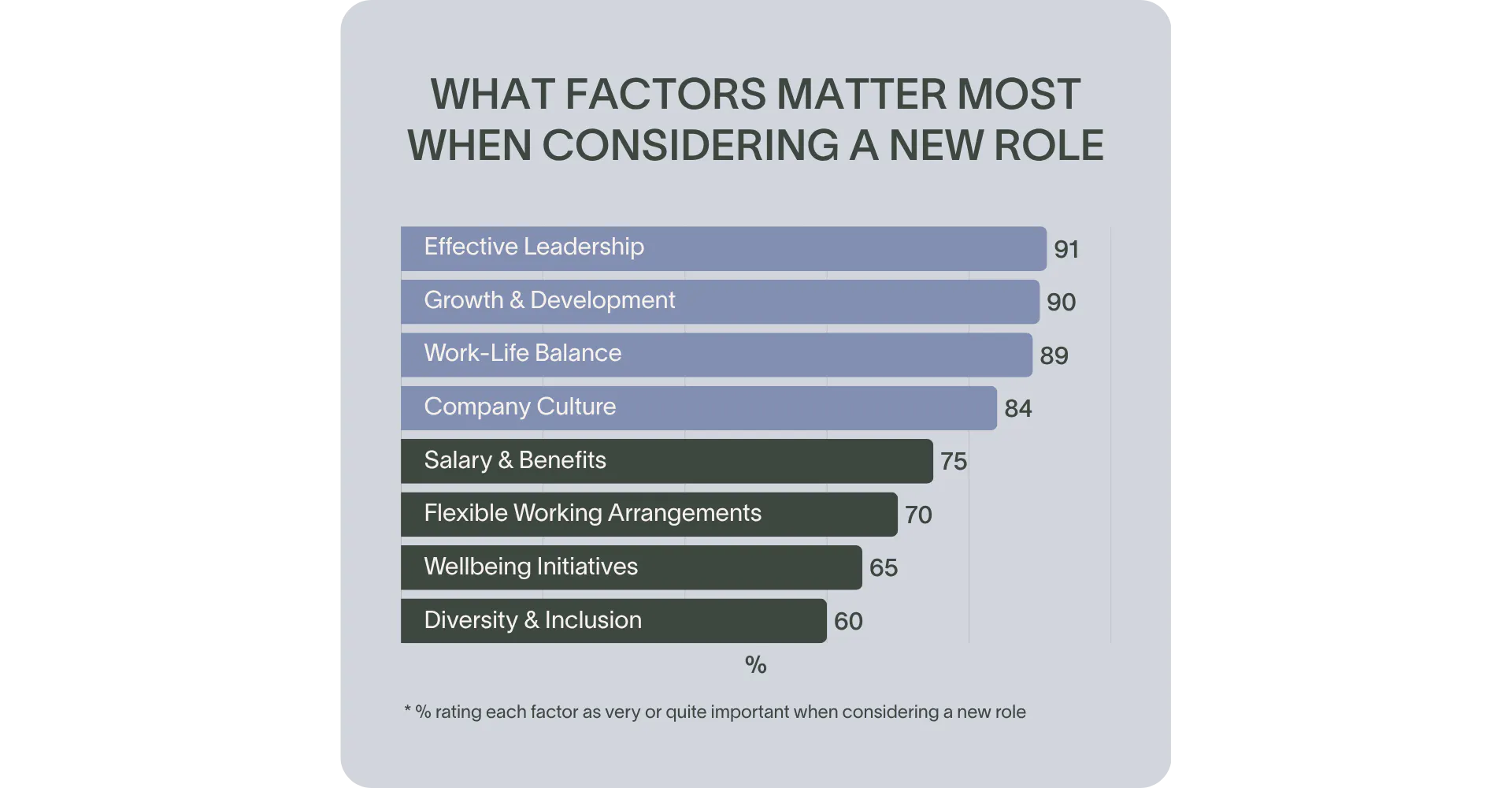
What these factors have in common is that they shape an employee's confidence in their future with an organisation:
Together, they help answer a question employees continually assess, often without consciously realising it: Is this still a place where I can see myself succeeding?
This is where retention risk often begins. Employees rarely leave the moment a problem appears. More often, they leave after a period in which one or more of these factors starts to weaken. Development opportunities become less visible. Confidence in leadership declines. Flexibility becomes harder to access. The role begins taking more than it gives back. Each change may seem insignificant in isolation, but collectively they can weaken an employee's belief that they have a meaningful future within the organisation, long before they begin exploring other opportunities.
For leaders, the challenge is that these indicators are often harder to measure than remuneration and may receive less attention as a result. Most organisations can quickly benchmark pay against the market. Fewer can confidently assess whether high performers believe they have a future, trust the direction of the business, or feel their contribution is helping them progress towards meaningful goals.
The practical takeaway is that retention should be viewed less as a compensation challenge and more as an early-warning system for the employee experience. By the time an employee resigns, the decision has often been forming for months. The organisations most likely to retain talented people are not necessarily those that pay the most - they are the ones that recognise when employees begin to question their future with the organisation, and address the underlying causes before that uncertainty becomes a decision to leave.
Respondents expressed low levels of confidence in their employer's support for professional development and career advancement, pointing to a widespread perception that career growth is not receiving enough attention.
The comments suggest the issue is not simply a lack of training. For many employees, the real concern is the absence of a visible path forward. Development was often described as unclear, inconsistent, or limited to occasional conversations that failed to translate into meaningful action. When respondents were specific about what they wanted, the requests were remarkably practical: clarity about future opportunities, access to relevant learning, and managers who had given genuine thought to their growth.
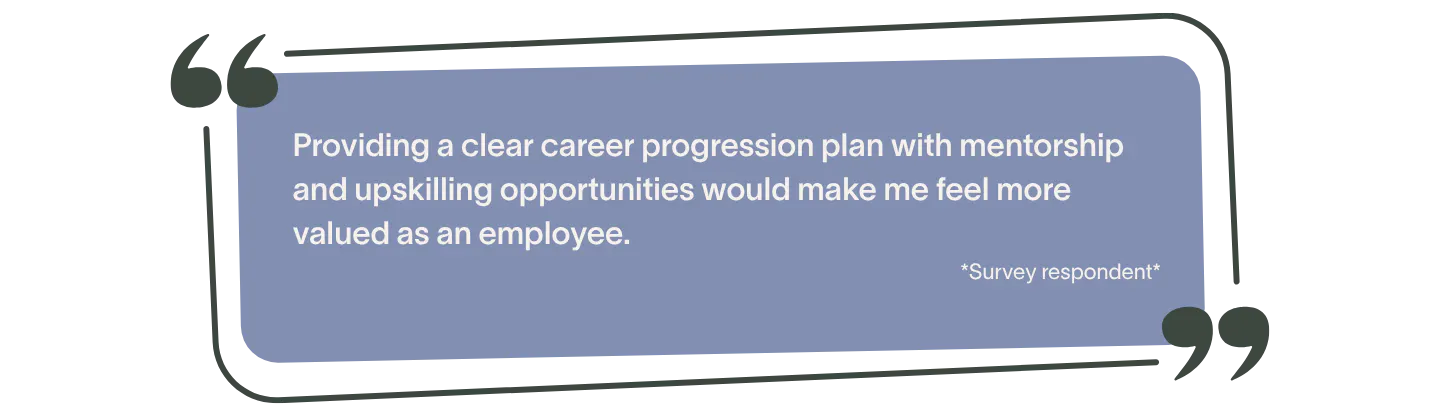
One respondent described wanting a personalised capability plan: evidence that someone in the organisation had thought seriously about their future. That request points to a broader issue. Career development is not just about building skills. It is one of the clearest signals employees receive about whether the organisation sees a future for them. When people cannot see opportunities to grow, progress, or take on greater responsibility, they often conclude that their future lies elsewhere.
The implications extend beyond retention. Deloitte New Zealand has reported that 75% of New Zealand employers face skills shortages and believe their workforce lacks capabilities needed to achieve strategic objectives. Yet many respondents described limited access to the very development opportunities that could help close those gaps. The challenge is not simply one of talent acquisition - it is also one of talent cultivation. Organisations searching externally for critical capabilities may be overlooking opportunities to build them internally.
What makes this finding particularly significant is that many employees have not disengaged from their own development. The comments suggest the opposite. Respondents described requesting training that never materialised, progression conversations that failed to lead anywhere, and ambitions that were acknowledged but never actively supported.
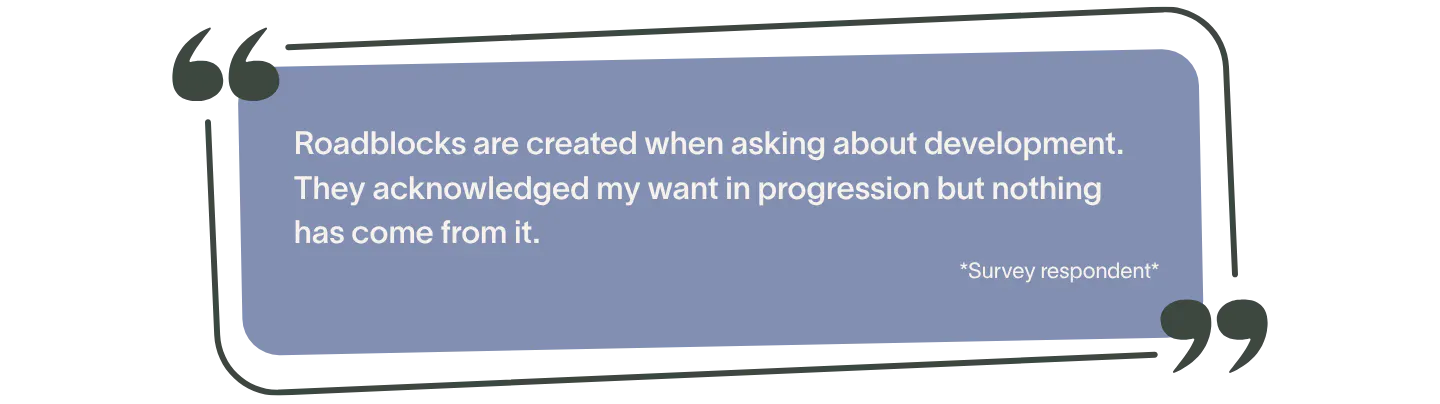
Career development is ultimately about creating confidence in the future. Employees do not need every step mapped out, but they do need evidence that progress is possible and that someone is invested in helping them achieve it. When organisations fail to provide that confidence, ambitious employees often conclude that their best opportunities lie elsewhere.
By a considerable margin, the strongest request when people were asked what they would most like to improve about the hiring experience was for feedback, not lengthy or detailed, but something specific. Any indication that a real person had engaged with their application, and a sense of why it had not progressed.
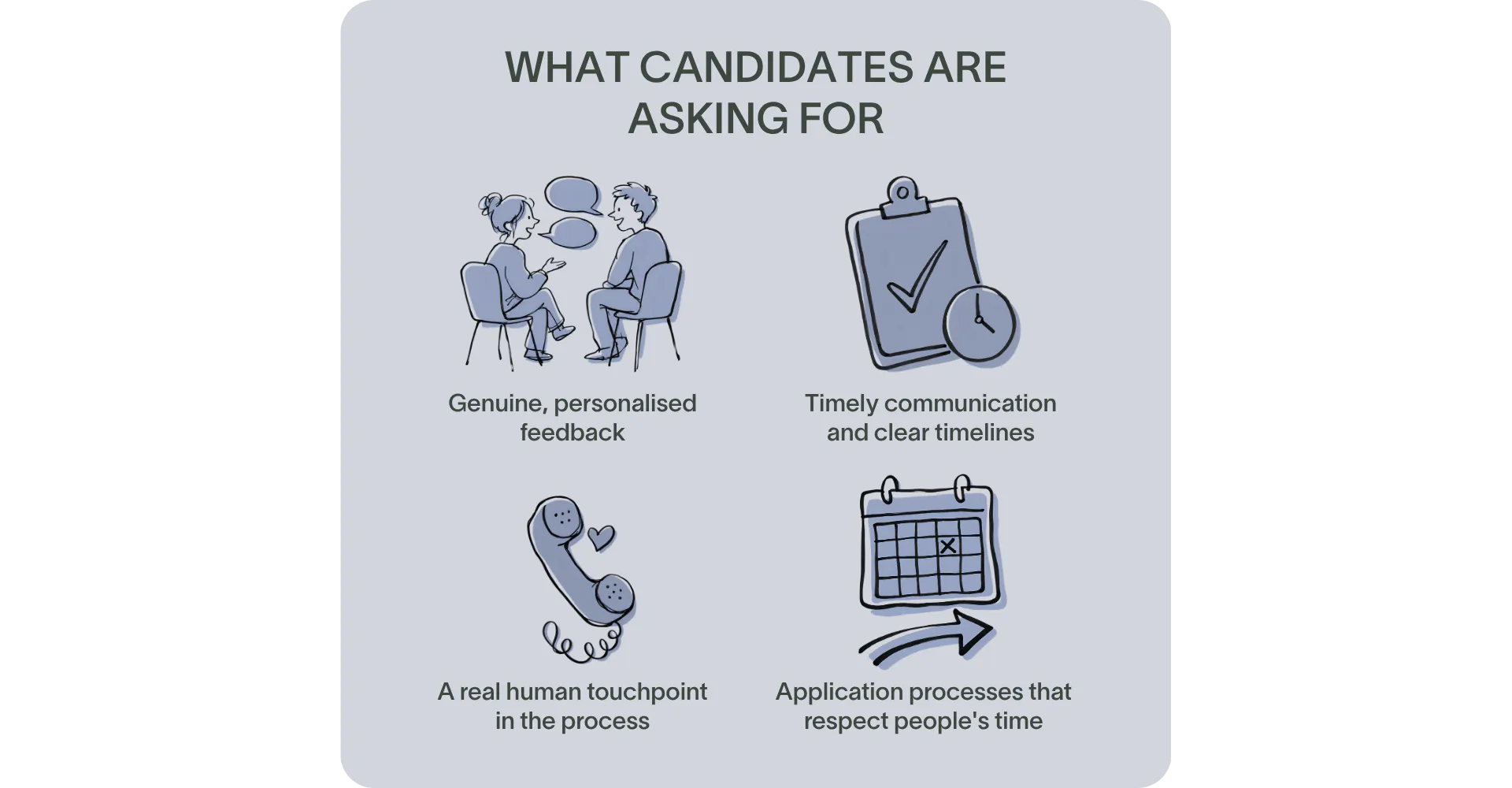
Several respondents described the cumulative effect of a process that had lost sight of the person on the other side. AI screening tools were seen as filtering out candidates before a human had looked at anything. Application systems asked people to manually retype information already on the CV they had just uploaded. Weeks passed without any update. One respondent put it plainly: "Employment is a human process and currently it is the most dehumanising process I have ever experienced."
For many people, the hiring process is their clearest window into what an organisation is really like. It shapes how they talk about that experience long after it ends. When the process feels thoughtful and considered, people remember it positively, even if they are not successful. When it feels impersonal or unclear, that is remembered too. The difference is rarely about process design. It is about the care taken in how that process is delivered, and it costs very little to fix: one sentence of specific feedback, tied to what the role actually needed, is the highest-leverage two minutes in the entire process.
The tone across the data on artificial intelligence was more positive than many might expect. Most respondents saw AI as a way to remove repetitive work and support better decisions, not replace their own judgement. Governance, oversight, and a human layer of review were treated as essential rather than optional, and speed was welcomed only so long as it did not substitute for considered decision-making.
That view was consistent across industries and seniority levels, not confined to any one group of respondents.
Microsoft's New Zealand research found that 84% of New Zealand knowledge workers are already using generative AI at work, higher than the global average. Yet KPMG and the University of Melbourne's research found that only 36% of New Zealanders believe they have the skills to use AI appropriately, and only 24% feel they can use AI tools effectively.
The gap between adoption and capability lands squarely in the career development space covered earlier. People are already teaching themselves AI on their own initiative, the same self-directed pattern that shows up whenever an organisation is not investing in someone's growth. A practical first step is to ask employees how they are currently using AI, then build capability development, governance, and expectations around those existing behaviours. This ensures policies reflect reality rather than assumptions.
More than half of respondents said they were either very keen or could be tempted to move overseas for career opportunities. At its core, this is not a retention challenge driven by geography. It reflects a perception that larger, more complex, or more accelerated career opportunities may be available elsewhere. For many employees, the attraction is not simply higher pay or a different location. It is the belief that moving abroad could expand their experience, accelerate their development, or open doors that feel harder to access in New Zealand.
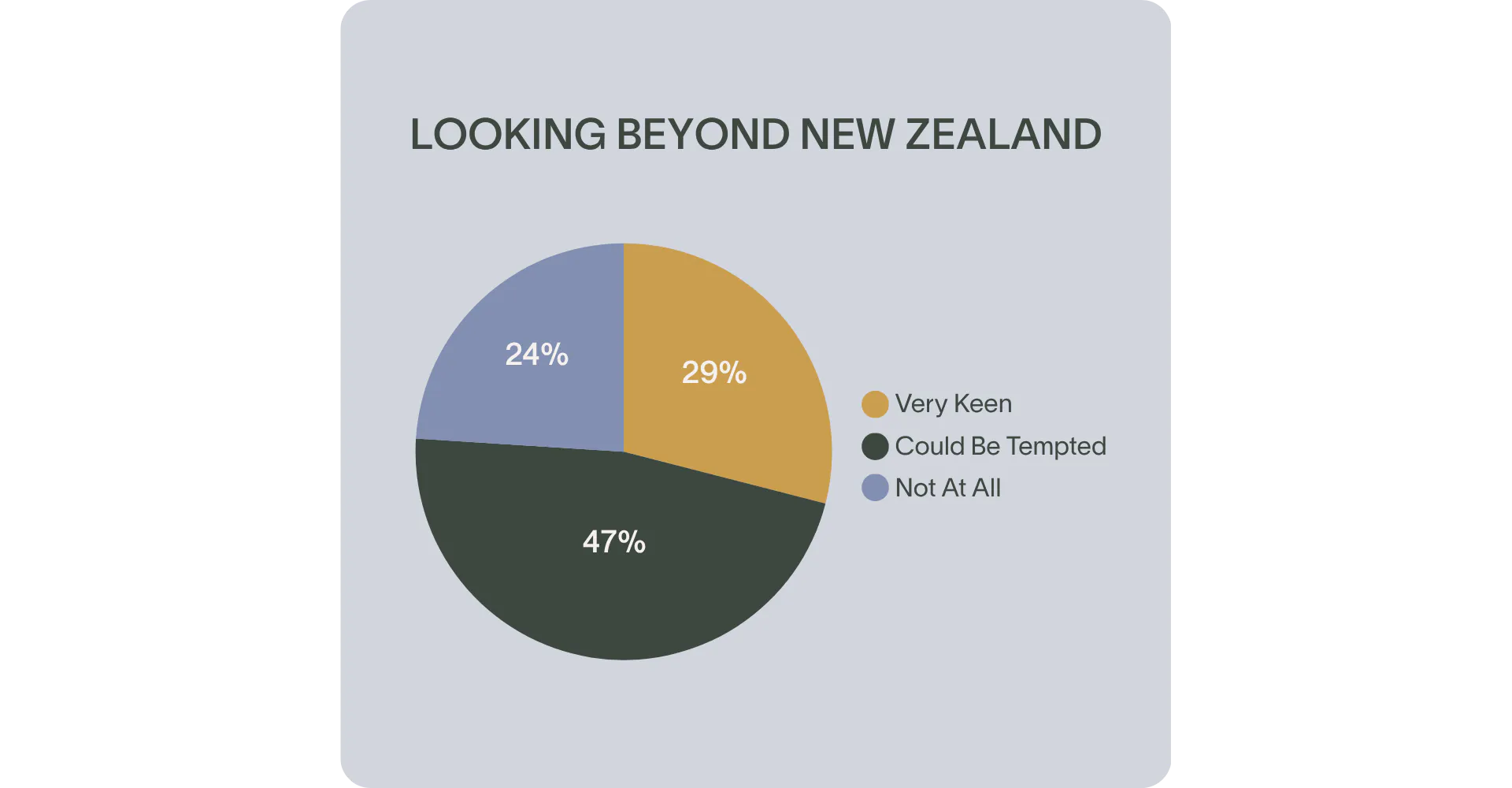
This finding is particularly relevant for organisations seeking to retain ambitious employees. Career-minded professionals rarely compare their current employer only against other local employers. Increasingly, they are comparing the opportunities available to them against a much wider international market. The real issue is not whether talent can leave, but whether employees believe they need to leave in order to achieve their goals.
At the same time, a significant proportion of respondents indicated they are not open to moving overseas at all. This finding suggests that ambition and international mobility are not synonymous. Many employees are willing to build their careers locally, provided they can see opportunities that match their aspirations. The challenge for employers is therefore not simply retaining talent, but creating enough visibility around future opportunities that talented people can imagine achieving their goals without leaving.
For leaders and HR, the priority is not to replicate everything an overseas market can offer. It is to ensure that talented people can see a future that is both visible and compelling. Employees are more likely to stay when they can access stretch assignments, build new capabilities, broaden their responsibilities, and see clear evidence that their career is moving forward. Then, overseas mobility becomes less a competitor and more a benchmark.
Over the course of this survey, employees rarely asked for dramatic change. Instead, they described a desire to be trusted, recognised, supported in their growth, and treated in ways that reflected the values their organisations claimed to uphold.
Taken together, these findings suggest that employee expectations are not becoming unreasonable. They are becoming more discerning. Employees are paying closer attention to whether an organisation's actions align with its intentions, and assessing that alignment through the everyday experiences that shape working life.
Perhaps the clearest lesson from this year of listening is that culture is built through consistency. Employees draw conclusions about trust, recognition, growth and leadership from hundreds of small interactions over time. Organisations that consistently get those moments right are not simply reducing turnover risk; they are creating workplaces where talented people can see a future worth investing in.
Insights drawn from the Convergence Workplace Culture Survey 2025. All data collected anonymously. Respondents represented a wide cross-section of seniorities and industries including manufacturing and logistics, banking and finance, science and technology, retail, consulting, and healthcare.
References:
Our Expertise


Level 4
57 Fort Street
Auckland Central
Auckland 1010
© 2026