Insights
Why Candidates Are Choosing Resilient Organisations
Today's candidates are evaluating more than culture and compensation. Discover how resilience is influencing hiring decisions in today's market.


Insights
Today's candidates are evaluating more than culture and compensation. Discover how resilience is influencing hiring decisions in today's market.
In a transparent market, candidates are looking beyond employer brands to resilience, trust, and leadership credibility.
The most significant shift in talent attraction over the past few years hasn’t been the rise of AI powered screening, skills matching or automation, even though each of those has undeniably changed how hiring gets done. The bigger shift has been quieter: the slow erosion of mystery, as organisations are no longer assessed through carefully crafted employer brand messages alone, but through what candidates can observe, infer and verify long before an offer is ever on the table.
As that visibility grows, something else comes into sharper focus: resilience, not as a wellbeing programme or a line in a values deck, but as a genuine organisational capability, the capacity to stay coherent, grounded and human when complexity inevitably shows up. A growing number of candidates are responding to that quality whether they can name it or not, and it’s becoming one of the strongest signals shaping who they choose to join.
AI has accelerated this shift, and so have professional networks, social platforms and the kind of informal, peer to peer insight that travels fast in a market as small and interconnected as New Zealand’s. Increasingly, they're using the hiring process to assess organisational behaviour in real time. Delayed decisions, inconsistent messaging and leadership communication all become clues about what it might actually feel like to work inside the organisation.
New Zealand's labour market remains tight, but the sentiment within it has shifted. After several years of economic uncertainty, restructures, and changing workplace expectations, many professionals are approaching career decisions more cautiously. Candidates are still open to new opportunities, but they are increasingly looking beyond job titles, salary packages and employer brands. Instead, they're paying closer attention to how organisations operate beneath the surface - how leaders communicate, how teams navigate pressure, and how businesses respond when conditions become challenging.
Trust provides an important lens through which to understand this shift. National surveys suggest that while most New Zealanders continue to trust their own employer, the proportion reporting high levels of trust has softened since 2024, with the decline most pronounced among younger workers - the very demographic many organisations are competing hardest to attract and retain.
In a more transparent labour market, changes in trust rarely remain confined within an organisation. Experiences are shared across professional networks, social platforms and peer conversations, influencing how candidates assess potential employers long before they apply. As a result, organisational resilience has become far more visible. Candidates are paying attention not only to what organisations say about themselves, but also to the signals that reveal whether they can maintain trust, stability and credibility when circumstances become difficult.
Experienced candidates understand that every organisation faces periods of uncertainty. Rather than looking for a flawless employer, they are paying closer attention to how organisations navigate complexity, respond to setbacks and lead through change.
New Zealand research continues to point to trust, psychological safety and credible leadership as the forces that stabilise organisations through disruption. Organisations that hold onto trust through periods of change tend to preserve engagement, decision quality and the pace at which people learn and adapt, and from a talent attraction standpoint, that stability is deeply reassuring. It suggests standards are high but human, and that pressure gets absorbed by the system rather than passed down the chain unchecked.
One pattern we are seeing more frequently in final-stage conversations is a growing interest in how organisations perform during difficult moments. Candidates are looking beyond the opportunity itself and seeking evidence of resilience in action. They ask about restructures, missed targets and periods of uncertainty because these moments often reveal far more about an organisation than its successes ever can. Those moments tell us talent isn’t only gravitating toward businesses that move fast; it’s gravitating toward those that can sustain momentum without quietly burning people out along the way. Reliability, it turns out, is becoming a surprisingly powerful differentiator, one that’s quieter than a flashy employer brand campaign but arguably far more persuasive.
One of the clearest signals of resilience now shows up during recruitment itself, where hiring processes increasingly act as live, unscripted demonstrations of how an organisation actually operates, particularly in the moments when things don’t go exactly to plan. These conversations reveal far more than role scope or job title ever could; they offer candidates an early sense of how grounded and coherent an organisation genuinely feels, long before anyone signs an offer letter.
As transparency increases, the nature of talent attraction has shifted in ways that are subtle but significant. It’s no longer primarily about projecting a polished image of the organisation; increasingly, it’s about helping the organisation show up as it genuinely operates, while staying alert to the signals that might unintentionally chip away at confidence or trust.
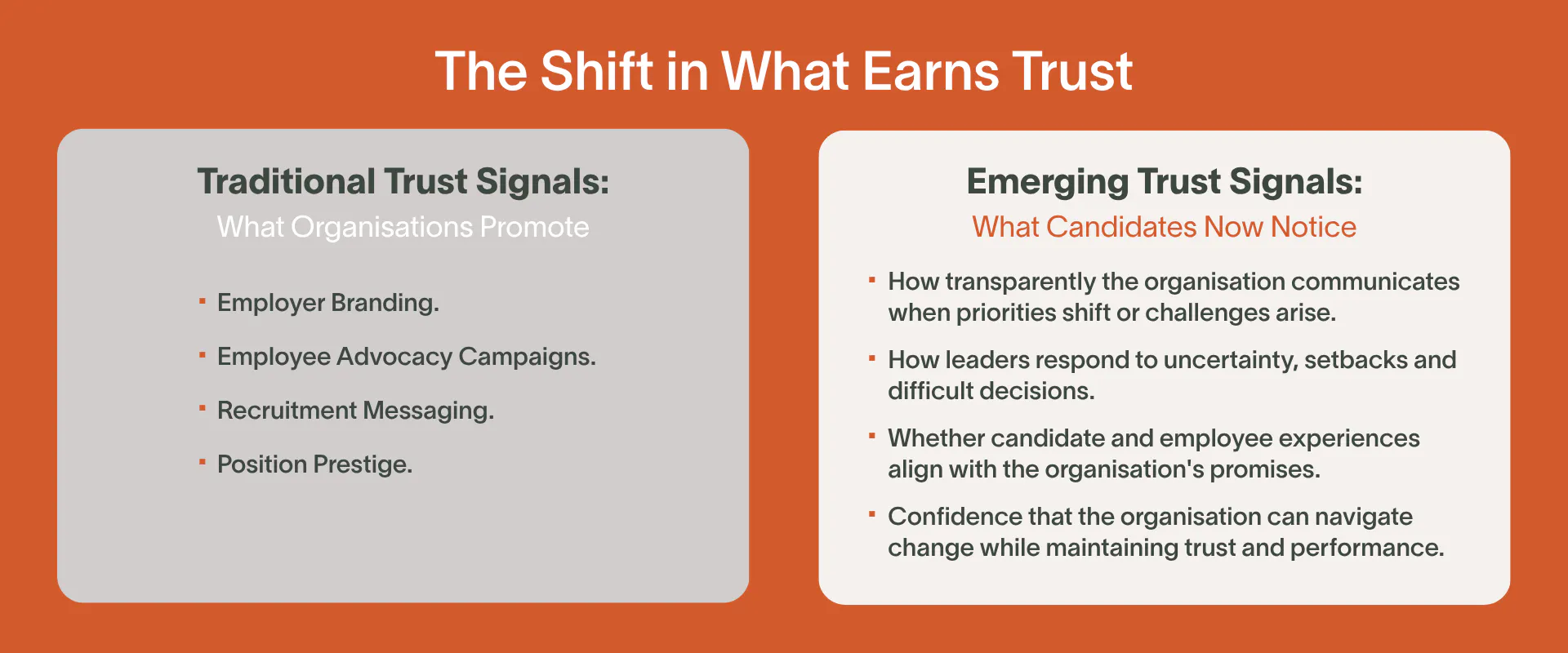
For HR and Talent Acquisition leaders, this shift has important implications. Recruitment processes are increasingly acting as trust-building moments rather than simply mechanisms for assessing candidates. Every interaction, from interview scheduling and communication updates through to feedback and offer management, shapes how resilient an organisation appears from the outside. Candidates are evaluating not only the opportunity itself, but also the behaviours, decision-making and leadership signals that sit behind it.
In this environment, the hiring experience itself has taken on new weight. Candidate questions, moments of hesitation and even the decisions people make to decline an offer increasingly reflect how resilient the organisation appears from the outside looking in, offering early insight into whether it seems steady, coherent and capable of absorbing pressure, or whether strain is already visible at the edges. Recruitment has quietly become both a gateway for talent and a feedback loop on organisational health, whether HR teams set out to design it that way or not.
This matters particularly here in New Zealand, where markets are tight, networks are closely connected and stories travel fast. In such a visible environment, attraction is shaped less by what an organisation says about itself and more by how closely the actual experience lines up with what was promised. Consistency, credibility and genuine follow through are no longer nice to have; they’ve become central to how organisations are read, remembered and recommended.
Resilient organisations rarely shout the loudest, and yet they’re becoming disproportionately attractive to the people who matter most. In a transparent market, qualities like consistency, composure and reliability are hard to fake and remarkably quick to recognise.
A theme gaining traction in leadership circles is that for many candidates, especially those who’ve already lived through a few cycles of change, these quieter signals matter more than an inflated title or a short term perk. That same steadiness rarely stops mattering once someone accepts. The organisations getting this right tend to have a quieter retention story too, fewer surprise exits, teams that hold together through the next round of change, hiring decisions nobody has to quietly revisit a year later. Talent attraction is no longer about convincing people to say yes; it’s about building an environment where saying 'yes' still feels right eighteen months on.
References:
Our Expertise


Level 4
57 Fort Street
Auckland Central
Auckland 1010
© 2026