Level 4
57 Fort Street
Auckland Central
Auckland 1010



And then a valued leader resigns, or a high performing specialist hands in their notice with genuine regret on both sides, and the organisation is left asking what it missed.
This has quietly become one of the most frustrating and costly talent challenges facing senior leaders. Not because people are visibly unhappy, but because the exits feel unexpected. The reality is that the exits that sting most tend to be the ones that never triggered a single warning sign.
Picture this: A General Manager at a mid sized professional services organisation recently described losing two of their most trusted senior leaders within the same quarter. Both had received strong performance reviews. Both had declined counter offers from competitors in the previous year. Neither had raised concerns in their one-on-ones. When the exit conversations finally happened, a theme emerged that had gone unspoken for months: both felt they had already given their best in that organisation, and quietly, without drama, they had arrived at the conclusion that there was nothing left to grow into. The organisation had no idea and the data had shown nothing.
It is a situation that comes up more than most leaders might expect. The people who feature in these conversations were not underperforming, not visibly disengaged, and not actively looking to leave. In many cases, they were performing at a genuinely high level right up until the moment they walked out the door.
This reflects something broader that is playing out across New Zealand workplaces. MBIE's Workers in New Zealand Snapshot 2025 shows that while 84 percent of workers report overall satisfaction with their employment, trust indicators and perceptions of managerial support have declined year-on-year, with high trust levels weakening noticeably across several demographic groups, including younger workers and Māori and Asian employees.¹
That gap between surface level satisfaction and deeper emotional connection is exactly where invisible disengagement tends to live. People are not necessarily disengaging from their tasks; they may be quietly stepping back from a sense of meaning, momentum, or personal evolution. They still deliver. They still care. But something essential has begun to erode beneath the surface.
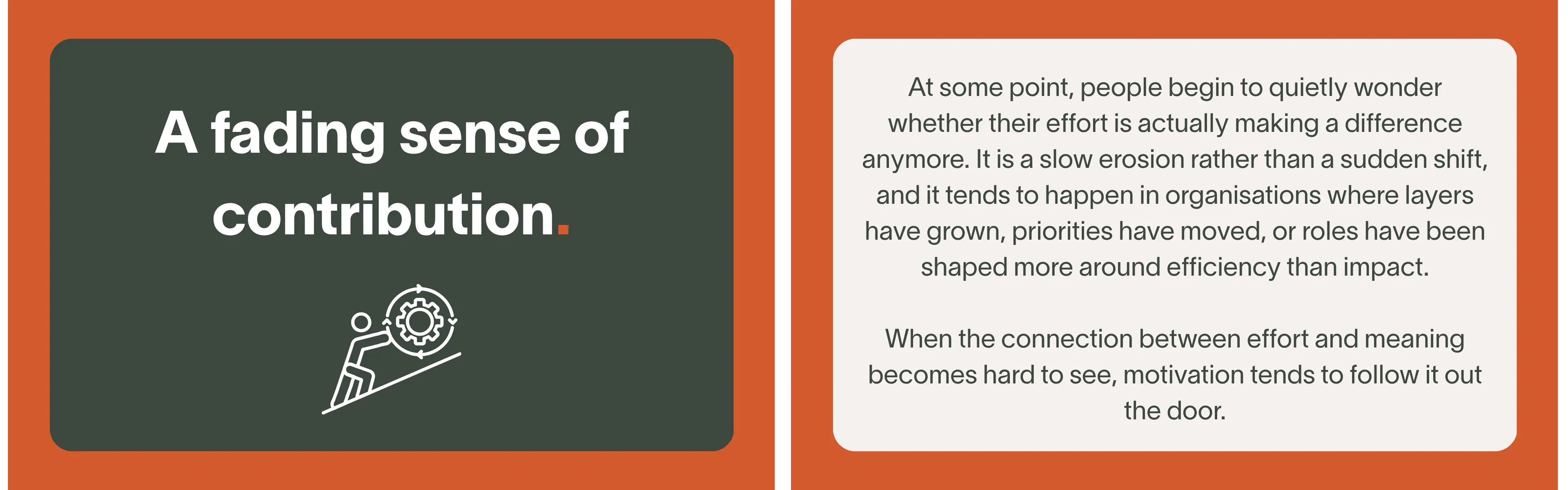
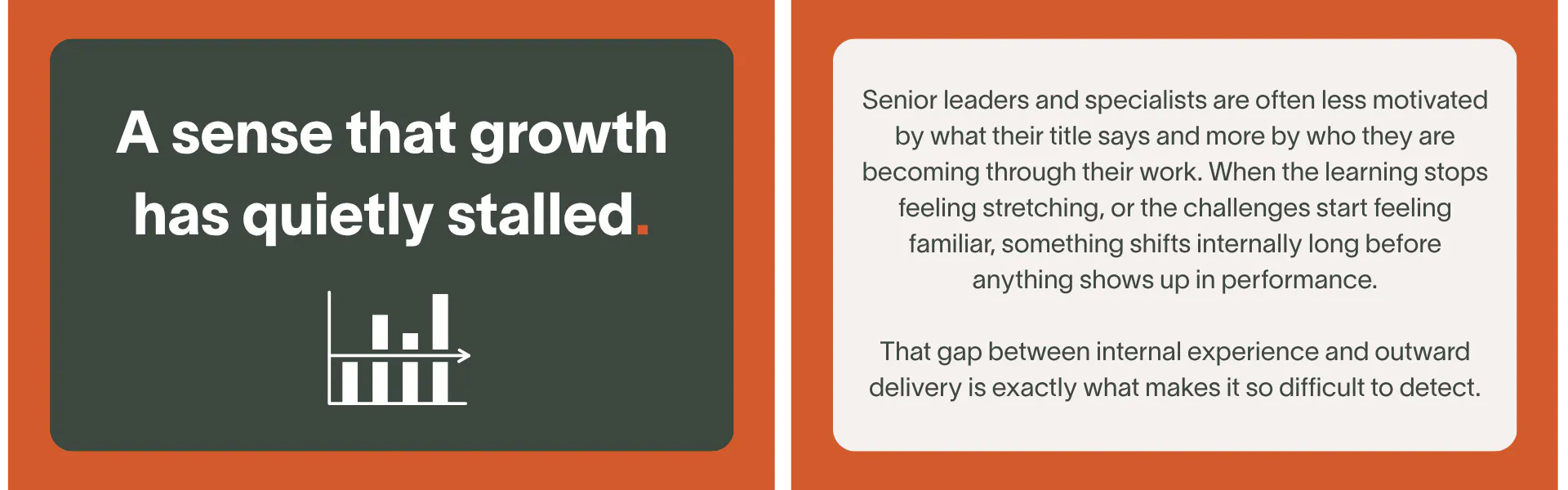
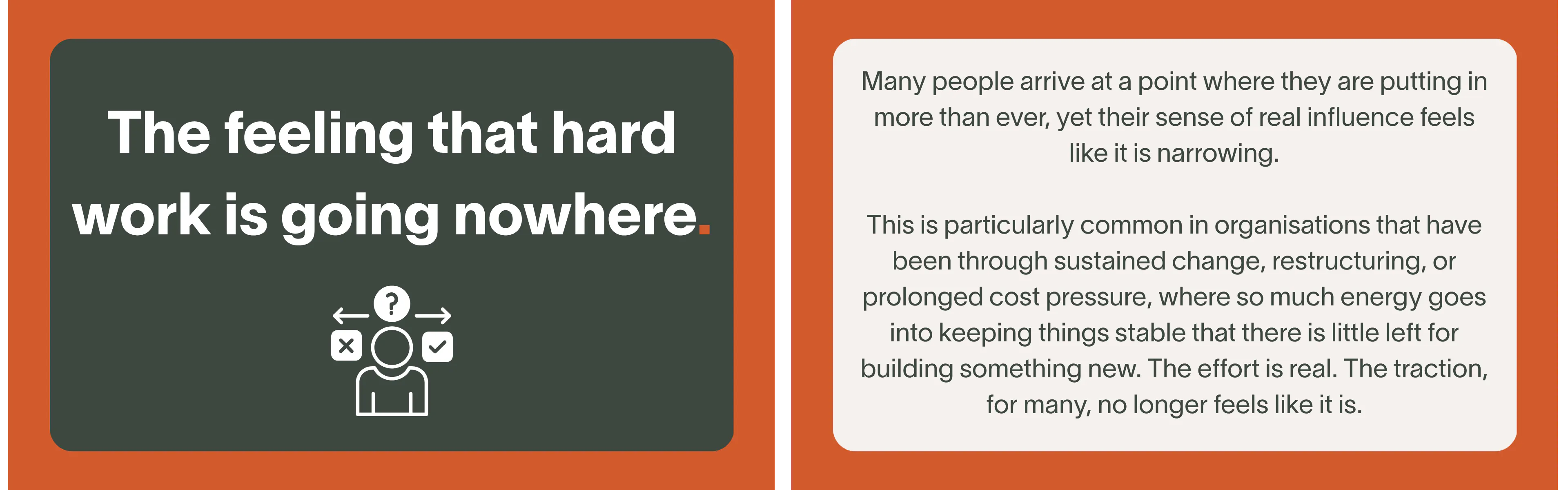
What emerges from these conversations tends to cluster around three themes, and none of them appear neatly on any dashboard. They compound quietly, beneath engagement scores and turnover metrics, until the day someone hands in their notice and everyone around them is genuinely surprised:
There is a dimension to these departures that is often underestimated - one that goes well beyond the direct cost of a replacement hire. When a quiet high performer leaves, they rarely leave alone in any meaningful sense:
This compounding effect plays out over months, not days. Teams that look stable on paper begin to slow in ways that are hard to attribute. Decision making becomes more cautious. Informal collaboration fades. The culture shifts slightly but perceptibly, in ways that engagement surveys are rarely designed to detect. By the time the pattern becomes visible, several more people may already be in the early stages of their own quiet reassessment.
It is this ripple effect that makes invisible disengagement such a serious organisational risk, and why catching the signals early matters as much for team stability as it does for individual retention.
For many leaders, the hardest part is not that the warning signs were ignored. It is that there were no warning signs to see.
Predictive retention models can track patterns of behavioural change, but they tend to measure what is already visible on the surface. The internal reassessment that precedes a departure, the moment someone quietly decides they have already given their best here, rarely produces a behavioural signal until the decision has already been made.
There is also a paradox worth sitting with. High value talent is more likely to leave before performance dips, not after. Their professionalism and internal standards mean they keep delivering even as their internal connection weakens. When they eventually leave, it feels sudden to the organisation, but for them it has usually been a long, thoughtful process that played out well below the waterline.
The MBIE Employer and Worker Monitor 2025 speaks to this in a way that is worth pausing on: while most workers report understanding their employment arrangements, one in six say their employer is not willing to listen to work related problems.² Listening, real and intentional listening, is where many of the most important signals tend to reside, and it is not something that can be replicated by a dashboard.
Invisible disengagement is not impossible to spot
It simply tends to reveal itself in quieter, more human ways than the metrics are designed to catch, and leaders who notice it early are usually the ones who stay genuinely curious about how the people around them are actually experiencing their work.
Listen for changes in language, not just attitude
People who feel genuinely connected to their work tend to speak in terms of purpose, ownership, and contribution. When that language gradually becomes more distant, for example, "my work" becomes "the role," or "what we are trying to build" becomes "what the organisation wants," it is often worth a gentle conversation to understand what has changed.
Notice when the extra layer quietly disappears
People rarely stop doing their jobs when they begin to disengage. What tends to change first is the voluntary contribution: the ideas offered unprompted, the decisions respectfully challenged, and the conversations shaped because someone genuinely cared about the outcome. When that starts to fade, it is easy to miss because everything on paper still looks fine.
Pay attention to emotional evenness
Disengagement does not always look like frustration. Sometimes it looks like a kind of settling, where wins are received quietly, setbacks accepted without question, and the emotional investment that once characterised someone's presence in a room has softened into something harder to read. That flattening is worth noticing.
Think about identity, not just performance
High performers tend to keep performing even when something important has shifted internally. A more revealing question is whether someone still experiences their role as part of who they are becoming - whether conversations about growth, learning, and future contribution are still alive. When those conversations quietly stop happening, that absence is often more telling than any performance metric.
Ask the open questions that rarely get asked
Some of the most useful signals surface in response to simple, genuinely curious questions: what feels energising right now, what feels like it is getting in the way, or where does your work feel like it is landing. Creating space for those conversations gives people permission to surface something before it has hardened into a decision that is already made.
Stay curious about whether effort feels worthwhile
Many people reach a tipping point not because they are unhappy, but because the connection between what they are putting in and what they are getting back (in meaning, influence, or growth), has quietly weakened. Asking how someone feels their contribution is landing, rather than simply whether the work is getting done, opens a very different kind of conversation.
The leaders navigating this most effectively seem to be moving away from purely role based development toward something more personal: growth anchored in identity rather than title. Instead of asking what comes next on a career ladder, they are asking who people are becoming through their work, and which parts of themselves feel underused or unexpressed.
These conversations tend to surface aspirations that do not always fit neatly into succession plans, but they matter deeply to retention. And perhaps more importantly, they reveal misalignment earlier, when there is still time to reshape a role, expand scope, or recalibrate expectations together, before someone has already decided the conversation is no longer worth having.
In a labour market where unemployment reached 5.4 percent in the December 2025 quarter,³ retaining trusted, high impact leaders is not simply a talent issue. It is a stability imperative that touches the organisation's ability to deliver on what matters most.
None of this is an argument against data. Analytics remain genuinely valuable. The organisations navigating this most effectively are those that pair data with human insight, using analytics to inform and conversation to truly understand. They equip their leaders to explore questions of meaning, not just metrics, and they hold leadership accountable not only for outcomes, but for the quality of experience people have in delivering them.
Quiet disengagement rarely leaves an obvious trail. More often, it reveals itself in hindsight, in the exits nobody saw coming and the conversations that never quite happened when they still could have.
Perhaps the more useful question is a simple one: if you asked your best people today whether their work still feels like growth, how confident would you be in their answer?
And if there is even a moment’s hesitation in that reflection, it may be pointing to something worth understanding now, while there is still time to act on it.
References:
Our Expertise


Level 4
57 Fort Street
Auckland Central
Auckland 1010
© 2026